Chemical Control
What is Chemical Control while using an Integrated Vector Management (IVM) Approach?
Chemical control refers to the use of specific compounds to either control immature mosquitoes (larvicides) or mature mosquitoes (adulticides). These methods are used to complement other Integrated Vector Management strategies, such as community education/outreach and physical control, to manage mosquito populations using environmentally conscious and data-driven strategies.
Only pesticides registered by the United States Environmental Protection Agency (US EPA) and California Environmental Protection Agency (CalEPA) are used by the District for mosquito control. The application of pesticides by the District is regulated by the California Department of Public Health (CDPH), California Department of Pesticide Regulation (CDPR), and Alameda County Agriculture/Weights & Measures.
Chemical Control - Larval Mosquito Control
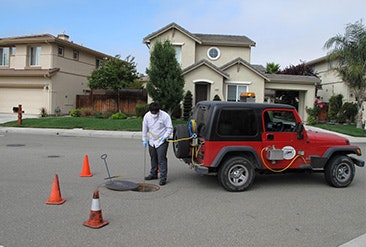
Three types of larvicides are used by the District:
- Biorationals (discussed in the Biological Control section),
- Growth regulators
- Surface films
Growth regulators
Methoprene and pyriproxyfen are insect growth regulators widely used by mosquito control districts throughout California and the country. They mimic natural insect juvenile hormones. When present in mosquito larvae habitats they disrupt mosquito larvae development, keeping them from maturing into adults and causing them to die in the pupal stage.
Surface films
Surface agents such as refined mineral oils or monomolecular films spread across the surface of the water to prevent mosquitoes from breathing. Mosquito larvae and pupae breathe through tubes called siphons that extend above the water surface. Depending on the product, the film may remain on the water’s surface from a few hours to a few days. Surface films are the only available products that are effective against late stage larvae and pupae.
Chemical Control - Adult Mosquito Control
Adulticides are insecticides that reduce adult mosquito populations for adult mosquito control treatments. The application method used to target adult mosquitoes is known as ultra-low volume (ULV) spray. A small amount of material (between 1/2 to 1 ounce per acre) is atomized into small droplets and broadcast in a fog aimed at where the adult mosquitoes are active. This method can be effective up to 300 feet away with ground applications and even further by aircraft with aerial applications, helping reduce the numbers of biting mosquitoes and the risk of mosquito-transmitted diseases.
The most common materials used for ULV spraying are classified as pyrethrins. Pyrethrin is a naturally occurring substance harvested from chrysanthemums, and it degrades within 4 to 6 hours after spraying. Pyrethroids, a synthetic form of pyrethrins, are also commonly used.
Adulticide treatment notifications are posted on our Mosquito Control Treatment page as soon as they are confirmed. The District will aim to provide the earliest notification of treatment possible. Scheduled treatments may be canceled and/or rescheduled due to weather or other unforeseen reasons.
