Innovative Mosquito Reduction in Alameda County
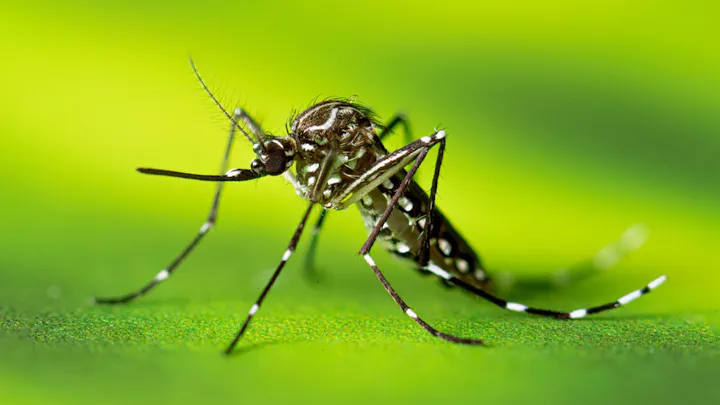
Working Together to Reduce the Yellow Fever Mosquito (Aedes aegypti) in Alameda County Communities.
No eggs hatch. Fewer female mosquitoes. Fewer bites.

Starting in July 2026, the Alameda County Mosquito Abatement District is implementing an innovative mosquito reduction program aimed at reducing the number of Aedes aegypti mosquitoes in Alameda County. The method used is referred to Incompatible Insect Technique and a naturally occurring bacterium, Wolbachia, is used.
This program involves male mosquitoes. Since male mosquitoes do NOT bite, they cannot spread diseases. There is no risk to people, animals, pets, or the environment, and Wolbachia cannot spread from mosquitoes to people or other animals.
Overview
Male Aedes aegypti mosquitoes carrying Wolbachia (wohl-BAH-kee-uh), a bacteria found in approximately 60% of insects, will be released within selected areas in Alameda County from July to October. The released male mosquitoes in this program, known as WB1 Males, are from MosquitoMate and are used to reduce local Aedes aegypti populations. Other mosquito and vector control agencies in California have successfully reduced Aedes aegypti mosquitoes by using this method.
- WB1 Males are registered with the U.S. Environmental Protection Agency (EPA) and approved for use in California by the CA Department of Pesticide Regulation (CDPR).
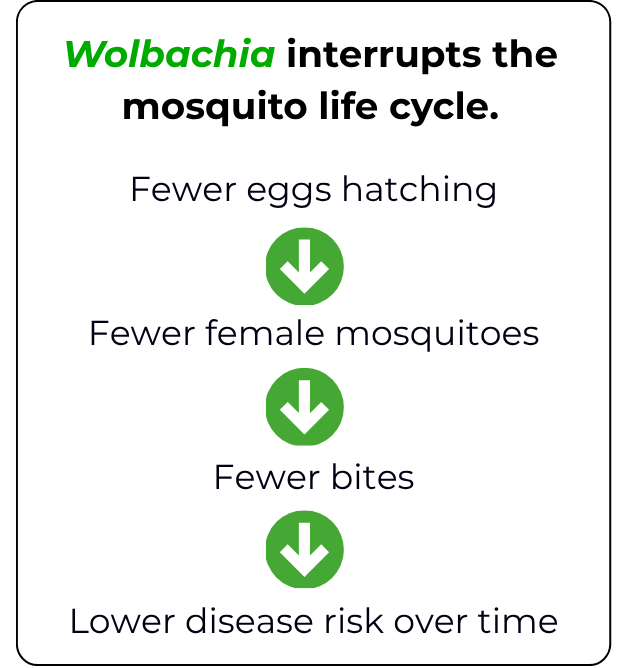
Wolbachia interrupts the mosquito life cycle
Once the released Wolbachia males mate with the female Aedes aegypti mosquitoes in the area, all eggs laid by the female do NOT hatch. This effectively decreases the Aedes aegypti populations in the area.
Why were these areas chosen?
As part of our commitment to using safe, effective, and environmentally responsible mosquito control, WB1 Males will be released from early July through October in selected areas in Livermore (shown on map below). The District will evaluate the program throughout the mosquito season to review data and operational considerations.
Residents are encouraged to sign up for updates by subscribing to our email list and selecting "Innovative Mosquito Reduction Updates."
Aedes aegypti mosquitoes were found for the first time in Livermore in 2025. This invasive mosquito species is an aggressive day-biting mosquito and can spread diseases such as dengue, Zika, and chikungunya.
Taking action now is crucial to reducing Aedes aegypti mosquitoes in Alameda County communities.
Key Information about the Releases
- The Wolbachia male mosquitoes (WB1 Males) were released in Areas A and B from July to mid-August on a weekly basis.
- The Wolbachia male mosquitoes (WB1 Males) will be released in Area C from July to October on Tuesdays and Thursdays.
- The Wolbachia male mosquitoes (WB1 Males) will be released in Area D from mid-August to October on Tuesdays and Thursdays.
- Due to operational considerations, the program will transition to Area E beginning in mid-October. Releases of Wolbachia-infected male mosquitoes (WB1 Males) will continue through late October.
- You will see District staff wearing uniform with our District logo doing door-to-door outreach answering questions and placing mosquito monitoring traps in the area.
- Male mosquitoes do not bite - they feed on nectar and fruit juices. Only female mosquitoes bite and can spread diseases.

Step-by-step on how Wolbachia works to interrupt the mosquito life cycle
- Male Aedes aegypti mosquitoes with Wolbachia are released by District staff.
- The released Wolbachia male mosquitoes mate with the female Aedes aegypti mosquitoes.
- After mating, the female mosquitoes lay eggs that do NOT hatch.
- Fewer eggs hatching leads to fewer female mosquitoes. Since only female mosquitoes bite, this means fewer mosquito bites and lower disease risk over time.


Learn more about the use of Wolbachia here:
The released male mosquitoes, known as WB1 males, are from MosquitoMate.
WB1 males are registered with the U.S. Environmental Protection Agency (EPA) and the CA Department of Pesticide Regulation.
Wolbachia cannot be spread from mosquitoes to people, pets, animals, or the environment.
- WB1 Males are a registered and approved technology and species-specific — it does not affect other organisms like pollinators or other mosquito species. It only affects female Aedes aegypti mosquitoes in the area.
Invasive Aedes mosquitoes, such as Aedes aegypti, are very difficult to control once they are established in an area.
Here are some of the reasons why invasive Aedes mosquitoes, like Aedes aegypti, are difficult to control:
- These mosquitoes, also referred to as "ankle biters", have evolved to thrive in populated areas. They prefer to bite humans and lay eggs in small, hidden water sources, sometimes as small as a bottle cap.
- They also lay eggs that can survive 6+ months outside of water on the sides of containers and plants in and around homes (different from local/native species). This mosquito is often transported to new areas in the egg stage.
- Additionally, several invasive Aedes populations have developed resistance to pesticides used for adult mosquito control.
By using an environmentally safe tool from our Integrated Vector Management (IVM) toolbox, the District aims to decrease the number of Aedes aegypti mosquitoes in the area. Fewer mosquitoes mean fewer biting females, reduced nuisance and public health impacts, and a lower risk of transmission of mosquito-borne diseases such as dengue, chikungunya, and Zika.
What can residents expect from July to October
Residents may see more male mosquitoes around the neighborhood. However, these released male mosquitoes do not bite or spread diseases!
Residents can expect to see District staff:
- Doing community & door-to-door outreach to answer any questions from residents
- Releasing the Wolbachia male mosquitoes weekly from July to October
- Monitoring progress by placing mosquito monitoring traps in the area
District staff are only in the community for mosquito work and wear uniforms with our District logo. We are not connected to and do not report to city, immigration, or law enforcement agencies.
We encourage residents to help us by:
- Dumping, draining, and removing standing water in and around your home - use the examples below and our backyard checklist to get started!

- Cover lawn drains with window screen mesh to keep mosquitoes from laying eggs
- Treat standing water that cannot be drained with larvicides containing Bti
- Use EPA-registered repellents containing:
- DEET (note: this is not DDT, which was an insecticide banned in the United States in the 1970s)
- Picaridin
- IR3535
- Oil of Lemon Eucalyptus (note: this is not the same as lemon eucalyptus essential oil)
Together, we can reduce Aedes aegypti mosquitoes in Alameda County.