
Invasive Aedes aegypti in Alameda County
Where have Aedes aegypti mosquitoes been found in Alameda County?
Aedes aegypti mosquitoes have been found in Alameda County since 2024. Since the initial detection, the Alameda County Mosquito Abatement District (ACMAD) has detected numerous adult and larval Aedes aegypti mosquitoes in several areas of Alameda County.
The following timeline shows when Aedes aegypti mosquitoes were first detected in Alameda County cities:
- 2024: Pleasanton
- 2025: Livermore, Dublin, and Fremont
- 2026: Castro Valley and Hayward
What is Aedes aegypti?
Aedes aegypti, also known as "ankle biters" or the yellow fever mosquito, is an invasive species native to Africa and it is a growing concern in many California counties and communities since their introduction to California in 2013.
Since 2013, they have become established in the Central Valley, Southern California, and in parts of Northern California.
Since 2022, Aedes aegypti mosquitoes have also been found in the San Francisco Bay Area including Alameda, Contra Costa, Solano, Santa Clara, and San Mateo Counties.
Important things to know about Aedes aegypti mosquitoes:
Aedes aegypti mosquitoes are disease vectors, meaning they can transmit viruses that cause dengue, Zika, chikungunya, and yellow fever. These mosquitoes prefer to bite humans, making them a public-health concern in areas where they are present.
To date, no locally acquired cases of dengue, Zika, chikungunya, or yellow fever have been reported in Alameda County.
By reducing Aedes aegypti mosquito populations in Alameda County, we can help lower the risk of local mosquito-borne disease transmission.
Under warm conditions, Aedes aegypti mosquitoes can develop from egg to adult in as little as 7–10 days.
Female Aedes aegypti mosquitoes typically lay their eggs on the inner walls of man-made containers, just above the waterline. These eggs can survive dry conditions for months. When the water level rises and covers the eggs, such as after rainfall, watering plants, or refilling a container, the eggs can hatch and the mosquito larvae begin developing in the water.
This quick turnaround means even a small container can produce several generations (a single female Aedes aegypti mosquito can lay from 50-300 eggs in her lifetime!) in a single season.

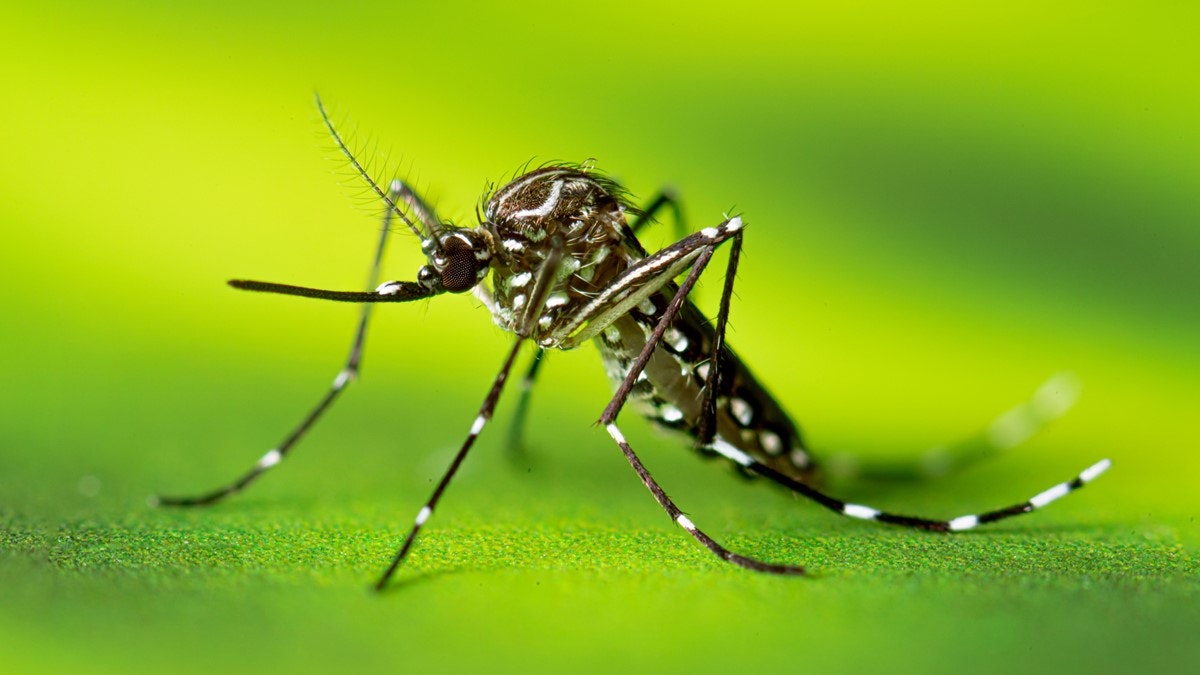
Aedes aegypti is a small mosquito and has a distinct black-and-white pattern.
Characteristics include:
- White stripes on the legs
- A lyre-shaped whitemarking on the upper back (thorax)
- A tendency to bite aggressively during the daytime, often around ankles and lower legs
- Activity in and around homes, including indoors
IMPORTANT - Not all mosquitoes with black-and-white legs are invasive Aedes aegypti mosquitoes.
Some native mosquito species in Alameda County have similar markings and may be mistaken for this invasive species. Because different mosquito species can look alike, the Alameda County Mosquito Abatement District encourages residents to submit the form below or request an insect identification through the Service Request form.
Found a small mosquito with black-and-white legs that bites aggressively around your ankles and legs during the day in Alameda County? Let us know by reporting it below.
Please place the mosquito in a Ziplock bag to preserve the sample. District staff will contact you to share findings and, if needed, discuss next steps.
Where do Aedes aegypti mosquitoes grow?

Aedes aegypti mosquitoes have uniquely adapted to human environments and prefers to lay eggs in small containers, often close to homes. Unlike most of our native mosquitoes in Alameda County, Aedes aegypti use a wide range of standing water sources, such as small, man-made containers found around homes and yards.
Common mosquito breeding sources include:
- Plant saucers and fountains
- Buckets and watering cans
- Rain barrels
- Outdoor toys
- Tarps and yard litter in containers (such as recycling cans in bags)
- Pet water dishes
- Plant propagation containers and flower vases (indoors and outdoors)
These sources are also referred to "cryptic" sources, meaning they tend to be hidden and often overlooked.
Aedes aegypti eggs can survive dry conditions for months. When water returns, the eggs hatch and allows mosquitoes to start and complete their life cycle within 7-10 days.
How can I prevent Aedes aegypti mosquitoes around my home?
The most effective way to prevent Aedes aegypti mosquitoes in and around your home is to remove standing water and empty, drain, and dry all outdoor containers, including plant saucers, buckets, toys, and anything else that can collect rain or irrigation water.
Other ways to prevent mosquitoes around your home include:
- Keeping yards tidy and storing items under in sheds or upside down helps reduce unexpected breeding sources.
- Repairing or replacing window and door screens can help keep mosquitoes outside, and using fans—indoors or on patios—can make it harder for mosquitoes to land and bite.

Protecting yourself from bites is also important. Residents can wear long-sleeved shirts, pants, socks, and shoes when mosquitoes are most active. Repellents containing EPA-registered ingredients such as:
- DEET (note: this is not DDT, which was an insecticide banned in the United States in the 1970s)
- Picaridin
- IR3535
- Oil of Lemon Eucalyptus (note: this is not the same as lemon eucalyptus essential oil)
also provide effective protection. Residents should also follow age-appropriate guidance for children and consult a pediatrician for safe repellent options for infants.
What is ACMAD doing about invasive Aedes mosquitoes in Alameda County?
The Alameda County Mosquito Abatement District (ACMAD) monitors and controls invasive Aedes aegypti and other mosquito species throughout Alameda County through the following activities:
- Conducting door-to-door outreach to identify and eliminate standing water, educate residents, and perform mosquito control when necessary.
- Placing mosquito monitoring traps to detect and track mosquito activity.
- Performing area-wide mosquito control treatments when needed to help reduce invasive mosquito populations.
Mosquito control is a community effort. Help your neighborhood by removing standing water to prevent mosquitoes.
Aedes aegypti mosquitoes commonly breed in small containers of standing water in and around homes, residents play an important role in preventing their spread. By regularly checking for and removing standing water around your home, Alameda County residents can help reduce mosquito breeding and support ACMAD's mosquito control efforts.
For questions, consultations, or to report unusual mosquito activity, contact the Alameda County Mosquito Abatement District at 510-783-7744. District staff can help residents identify mosquitoes, eliminate breeding sources, and stay informed about local mosquito activity.

